

Renovation of the Tower Roofs of Lund Cathedral
The renovation of the tower roofs at Lund Cathedral, Sweden, is a unique project where nearly 900 years of cultural heritage meet modern engineering. Through advanced scaffolding solutions, weather protection, and structural calculations, HAKI enabled a safe and efficient renovation – while keeping the cathedral open to visitors. The project’s technical complexity and high quality were rewarded with the Grand Prize at Construction of the Year 2024.
Background – a historic undertaking
Lund Cathedral is one of Sweden’s most renowned and culturally significant buildings. Construction began as early as 1080, and the cathedral remains an active place for worship, visitors, and tourism. Its two 55-metre-high towers – locally known as Lunnapågarna – are among the city’s most distinctive landmarks.
After more than 100 years without a complete roof replacement, it became clear that the tower roofs were in urgent need of renovation. Wear, ageing materials, and previous patch repairs meant that a comprehensive restoration was required, while at the same time ensuring that the building’s great cultural and historical values were preserved. Throughout the project, the cathedral also needed to remain open to visitors.
Technical complexity and HAKI’s role
Renovating the roofs of a nearly 900-year-old building that is visited daily placed exceptionally high demands on planning, precision, and safety.
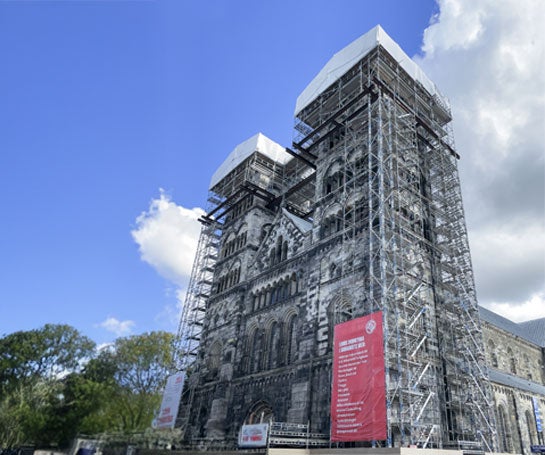
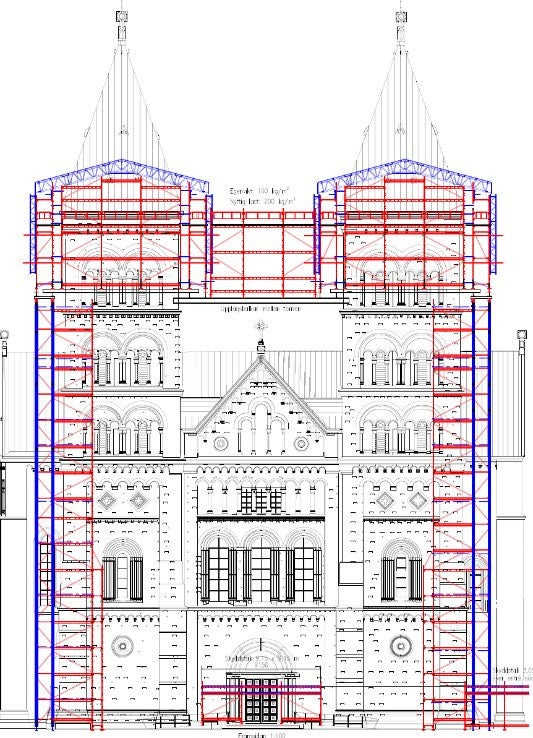
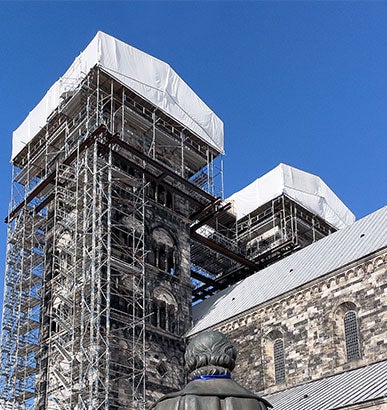
HAKI was responsible for the design and structural calculations of the scaffolding systems, the dimensioning of weather protection, and a bespoke solution using steel beams that carried the entire load of the scaffolding system – without placing any load on the culturally significant structure itself.
“We had to think in completely new ways – scaffolding systems that support their own weight through specially designed steel beams allow us to avoid loading the cathedral walls directly,” says Patrik Lennartsson, Project Engineer at HAKI.
To minimise disruption at ground level, Sydställningar, together with HAKI, developed a solution consisting of four independent scaffolding towers, pre-assembled scaffolding installed at height, and steel beams weighing between 2.5 and 4.5 tonnes. The beams were inserted through the towers and served as the primary support for the scaffolding system.
HAKI tripods were positioned at the corners to accommodate high leg loads while reducing the need for wall tie-ins, thereby minimising impact on the façade.
“As technical support, we take full design responsibility and always work in close dialogue with the customer to develop tailor-made drawings, calculations, and solutions that meet both safety and quality requirements for complex projects like this.”, Patrik adds.
Lifting and placement in a tent hall
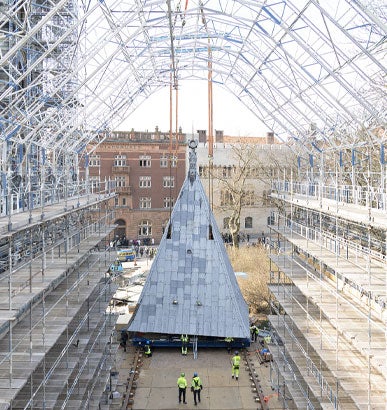
In March 2022, the two tower roofs were lifted down from the cathedral using specially engineered scaffolding and a powerful 500-tonne crane. The roofs were then placed inside a HAKITEC weather-protected temporary enclosure erected in Lundagårdsparken, adjacent to the cathedral.
The enclosure, measuring 40 metres in length, 22 metres in height, and 21 metres in width, was clad with a thick grey UV-resistant fabric and equipped with noise protection and fire walls. The polygon-shaped roof was assembled section by section, making it possible to smoothly lift down the tower spires and later reinstall them once the restoration work was completed.
Inside, the enclosure was fitted with scaffolding and lifting equipment, as well as an approved environmental zone designed to prevent the release of heavy metals and other hazardous substances during surface blasting and the removal of the old lead roofing.
Restoration in the hall and weather protection on the towers
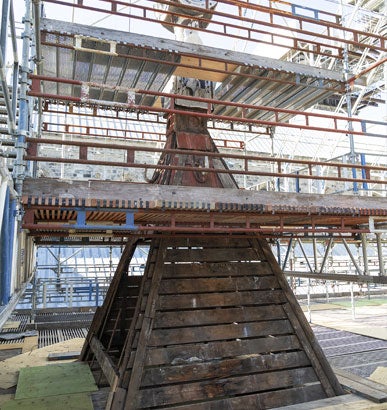
Within the weather-protected enclosure, blacksmiths, carpenters, and sheet-metal workers restored the tower roofs using new tin-coated metal sheets and repaired structural elements.
At the same time, the roofless towers on site were protected with HAKI’s weather protection systems. This made it possible for work such as rebuilding the masonry crowns to continue even during rain, snow, and wind.
“The weather protection provided full control over the working environment at height,” says Patrik. “It is a prerequisite for quality, safety, and adherence to the project schedule.”
Results – a landmark ready for the future
Once the restoration work was completed, the tower roofs were lifted back into place. The solution has been designed to last for at least 150 years – technically, aesthetically, and environmentally.
The project was completed in early 2023, in time for Lund Cathedral’s 900th anniversary. The result is a restored landmark where traditional craftsmanship, modern engineering, carefully executed load calculations, and well-designed weather-protection and environmental solutions work together seamlessly.
The renovation was awarded the Grand Prize in Byggindustrin’s Construction of the Year 2024, underlining the project’s technical excellence and cultural significance.
“This project shows how the right technology, precise calculations, and innovative solutions can protect people, the environment, and cultural heritage,” concludes Patrik Lennartsson. “For us at HAKI, it is a clear example of the value of tailor-made, holistic solutions.”
Looking to turn complex construction or renovation challenges into successful projects?
Contact HAKI for expert advice and innovative solutions.